cycleFIT in TU Wien Teaching
Courses of cycleFIT
Within project-based courses, students work on real-world questions related to cycling mobility at TU Wien. They develop concepts, analyse problem areas, and create prototype solutions. In this way, research, teaching, and university operations are directly connected.
cycleFIT deliberately involves students as idea generators, co-developers, and critical reflection partners. This creates practical solutions while at the same time fostering a dynamic learning environment in the sense of a living lab.
Below you will find an overview of all courses related to cycleFIT.
Courses winter semester 2026/27
A) Cartography & Active Mobility: Making Cycling Visible
The course combines two thematic areas: Cartography & Active Mobility and Sustainable Urban Freight Transport in the City of the Future. The general sessions are held jointly, while the thematic sessions are worked on in small groups.
During the course, students explore different aspects of cycling-related cartography and examine how information on cycling can be collected, processed, and communicated. Various forms of presentation are considered, ranging from digital information systems and interactive maps to printed materials and wayfinding in public space.
The focus is on developing reliable and well-structured information for cycling at different scales – from route guidance and bicycle parking to cycling services and other relevant facilities.
The results will serve as preparatory work for cycleFIT, a TU Wien-wide initiative that aims to structurally establish cycling at TU Wien and make cycling more visible in everyday university life.
B) Sustainable Urban Freight Transport in the City of the Future
The transport sector is a key area of action on the path towards a climate-neutral city. At the same time, urban commercial and freight transport is often considered less comprehensively than passenger transport in climate strategies and mobility concepts. However, freight transport accounts for a significant share of transport-related emissions while also being essential for supplying the city.
Students will explore the challenges and development perspectives of sustainable urban freight transport. The focus is on questions relating to freight demand, the organisation and development of freight transport, and its integration into urban climate-neutrality and mobility strategies.
Degree programme: Bachelor's Programme in Spatial Planning
The course offers students the opportunity to actively participate in the reparier:bar, the bicycle repair workshop at the Getreidemarkt campus. The focus is on the practical operation of the workshop, the organisation of workshops and events, and the further development of the reparier:bar as an open infrastructure for TU Wien.
Students independently take on tasks in the day-to-day operation of the workshop and learn how to organise and further develop an infrastructure facility within a university context. This includes coordinating with different stakeholders, organising appointments and events, and integrating the reparier:bar into the broader structures of cycleFIT and TU Wien.
For registration send a Mail to kurt.weninger@tuwien.ac.at and laetitia.boock@tuwien.ac.at
Degree programme: Elective Courses – Spatial Planning
Past Courses - Summer Semester 2026
In this course, students from the Architecture and Spatial Planning programmes contribute to the development of cycling infrastructure at TU Wien. The focus lies on designing a place for cyclists on campus that combines functionality with a strong spatial identity and recognisable character.
Programme: Master’s programme in Architecture and Spatial Planning
Within the MOVE.Walks, participants explore and discuss current concepts, designs, and implementations in mobility planning during guided walks together with experts on site. Across four thematic walks, different perspectives from practice – including politics, administration, planning, and business – are introduced and discussed.
Programme: Master’s programme in Spatial Planning
This course focuses on the everyday cycling routes of students and staff travelling to TU Wien. Based on the results of the latest mobility survey, selected routes are systematically analysed. Students evaluate the routes using a structured assessment framework, identify potential safety issues, map them spatially, and document their findings. The analysis is based on independent cycling of the routes and detailed documentation.
Open to: Students from all study programmes
This course introduces the fundamentals of transport planning, covering key topics such as system behaviour, walking, cycling, public transport, parking, level of service, street cross-sections and intersections, traffic safety, and external effects of transport systems.
Programme: Bachelor’s programme in Civil Engineering
Building on ideas developed during the winter semester, students in this course created functional and innovative prototypes related to the cycleFIT theme. The goal was to design user-centred solutions for a more bike-friendly TU Wien and to iteratively test, refine, and present them.
Working in established groups, students followed a design thinking process using methods such as sketches, wireframes, video mock-ups, technology probes, design workshops, and iterative prototyping and product development phases. Continuous presentations, feedback sessions, and user testing helped refine the concepts. The focus was on practical implementation, resulting in prototype products or services addressing concrete challenges of cycling on campus.
Programmes: Master’s in Digital Civil Engineering Science and Master’s in Media and Human-Centered Computing
Past Courses – Winter Semester 2025/26
In this course, students actively contributed to improving learning and working conditions at TU Wien by developing ideas to strengthen cycling mobility at the university. Inspiring national and international best-practice examples served as motivation and helped identify key success factors. At the same time, students analysed the specific framework conditions of TU Wien, including its multiple locations, the results of the mobility survey, and strategic goals defined by the rectorate.
Participants worked with a comprehensive set of existing data and analyses, enabling well-founded results. The aim was to develop practical and creative solutions that make cycling to and between university locations more attractive. The focus was on cycling infrastructure at TU Wien campuses as well as complementary communication measures.
Programmes: Architecture, Spatial Planning, Civil Engineering
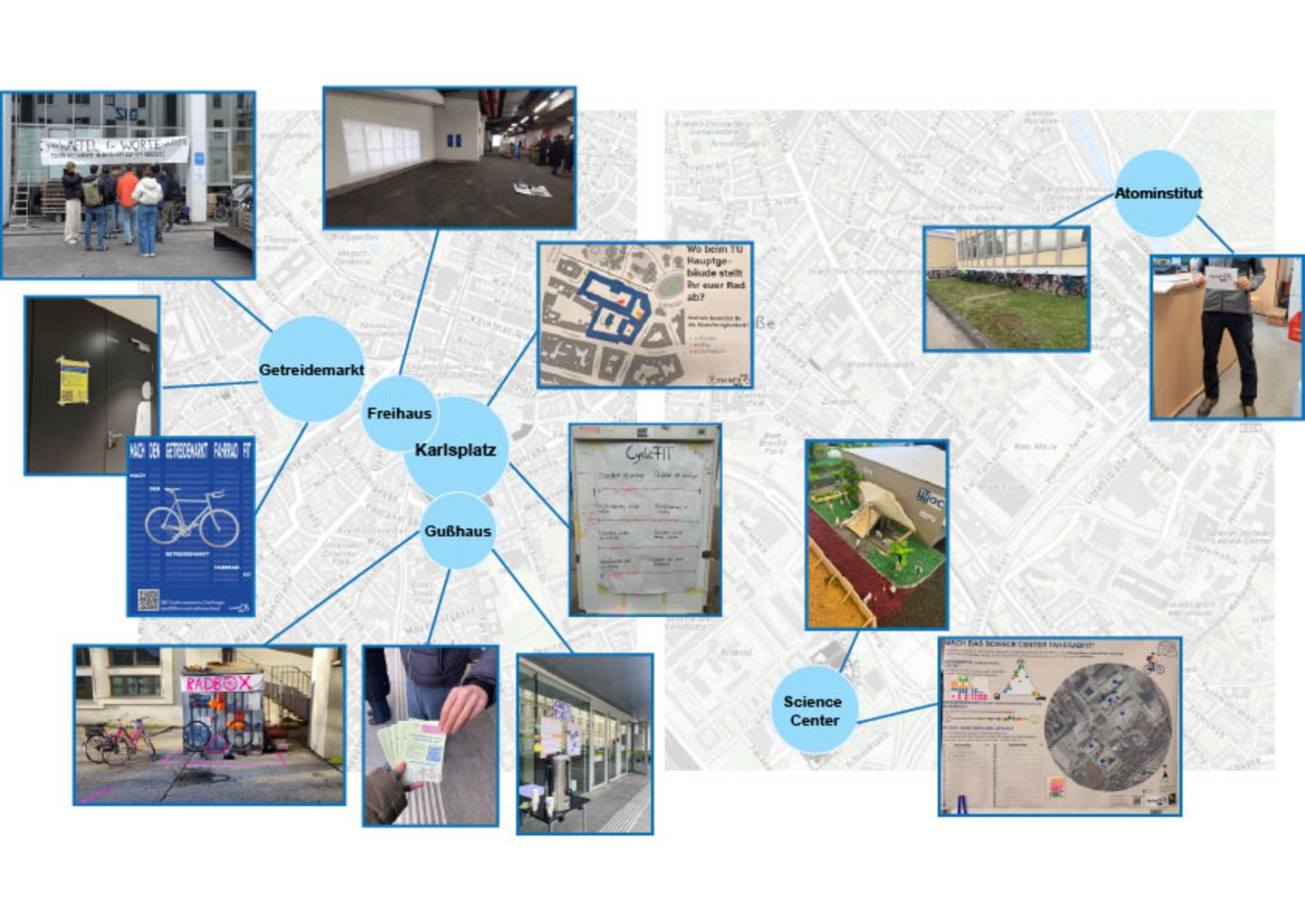
© cycleFIT
Winter Semester 2025/26 Impressions
As part of this course, several campuses of the TU Wien were first visited together in a large group during the so-called “Phase 0.” The aim of these site visits was to gain an initial overview of the spatial conditions and the existing bicycle infrastructure.On site, students observed, discussed, and documented different situations related to bicycle parking facilities, circulation routes, and surrounding public spaces.This joint exploration formed the basis for the subsequent work in the course. Initial impressions, identified potentials, and perceived barriers were then incorporated into the analysis and the development of ideas.
Degree programme: Bachelor’s Programme in Spatial Planning
Within this course, students worked in groups to develop interactive design concepts related to the annual theme cycleFIT, which aims to make TU Wien more bike-friendly and create user-centred solutions for everyday cycling on campus.
Using qualitative research methods and creative design techniques, students analysed real usage situations and challenges related to cycling at TU Wien. These included literature research, expert interviews, video observations, cultural probes, design games, and scenario development. The insights gained were integrated into an iterative design process supported by interim presentations, workshops, and collaborative group work.
Programmes: Master’s in Digital Civil Engineering Science and Master’s in Media and Human-Centered Computing