Doctoral Candidates
Our SOLVER Team consists of 5 academically exceptional doctoral candidates who are committed to science, and are strongly interested in pursuing a doctorate degree and carrying out research work in an interdisciplinary framework on the interface between engineering, materials science and medical biotechnology.
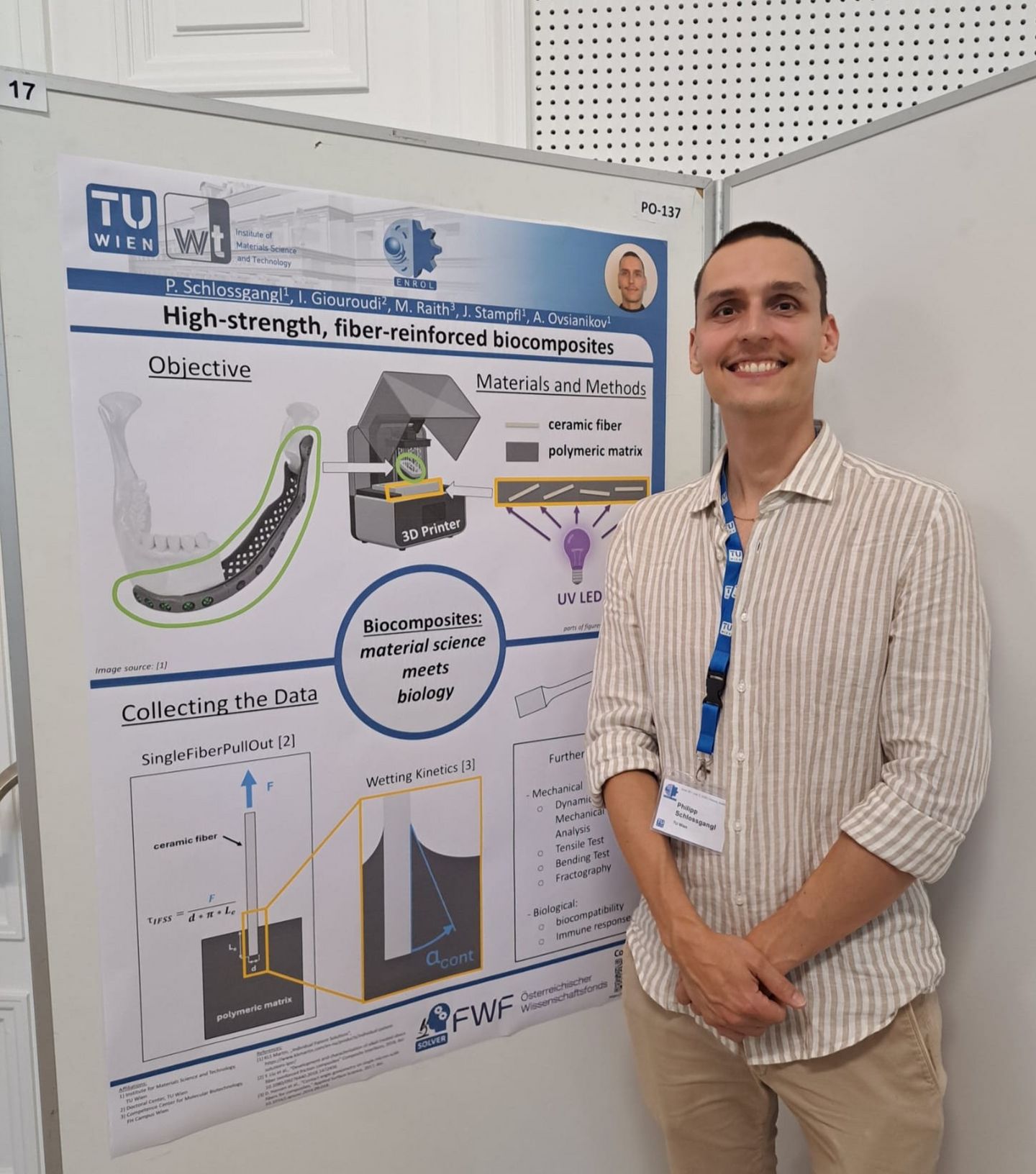
Philipp is a PhD student in the research group “3D Printing and Biofabrication” under the supervision of Prof. Aleksandr Ovsianikov. His research focuses on biomaterials for bone replacement, with particular emphasis on high-strength fiber-reinforced biocomposites. He holds a background in biomedical engineering with specialization in biomaterials and biomechanics. During his bachelor’s thesis, he was first introduced to photopolymerization, which sparked his interest in additive manufacturing. This expertise was further developed during his master’s thesis, where he worked extensively with photopolymeric resins in microfluidic applications and strengthened his CAD skills. Philipp combines strong analytical and problem-solving skills with a hands-on approach to experimental research. In his free time, he enjoys spending time in the mountains, training at the gym, and being with friends.
Contact Details: philipp.schlossgangl@tuwien.ac.at
![[Translate to English:] Peter Viragh](/fileadmin/_processed_/f/c/csm_Picture_peterviragh_f831b9f2aa.jpg)
Peter Viragh
Peter Viragh
Peter completed his BSc in Vehicle Engineering at the Budapest University of Technology and Economics, where his studies focused on advanced manufacturing technologies and bulk material characterization. He then obtained his MSc at Eötvös Loránd University in Materials Science, where he developed an interest in interfacial science through research on nanoparticle-based surface modifications and the characterization of surface properties. His equal interest in medicine led to his current PhD project, which focuses on enhancing the biological performance of bone implant surfaces. In this project biopolymer surface coatings are structured using femtosecond laser processing and characterized at physicochemical and biological levels.
Contact Details: peter.viragh@tuwien.ac.at

Veronica Viola
Veronica Viola
Veronica Viola received her master’s degree in Biomedical Engineering from PoliTO (Italy) in 2024. She is now part of the SOLVER Doctoral College, where she focuses on optimizing coronary stent design by investigating the effect of flow characteristics on vascular smooth muscle cells. By combining biological studies with CFD simulations, she aims to identify design parameters that minimize the risk of in-stent restenosis, ultimately enhancing vascular healing and stent efficacy.
Contact Details: veronica.viola@tuwien.ac.at
Sara Fueloep
Sara Fueloep
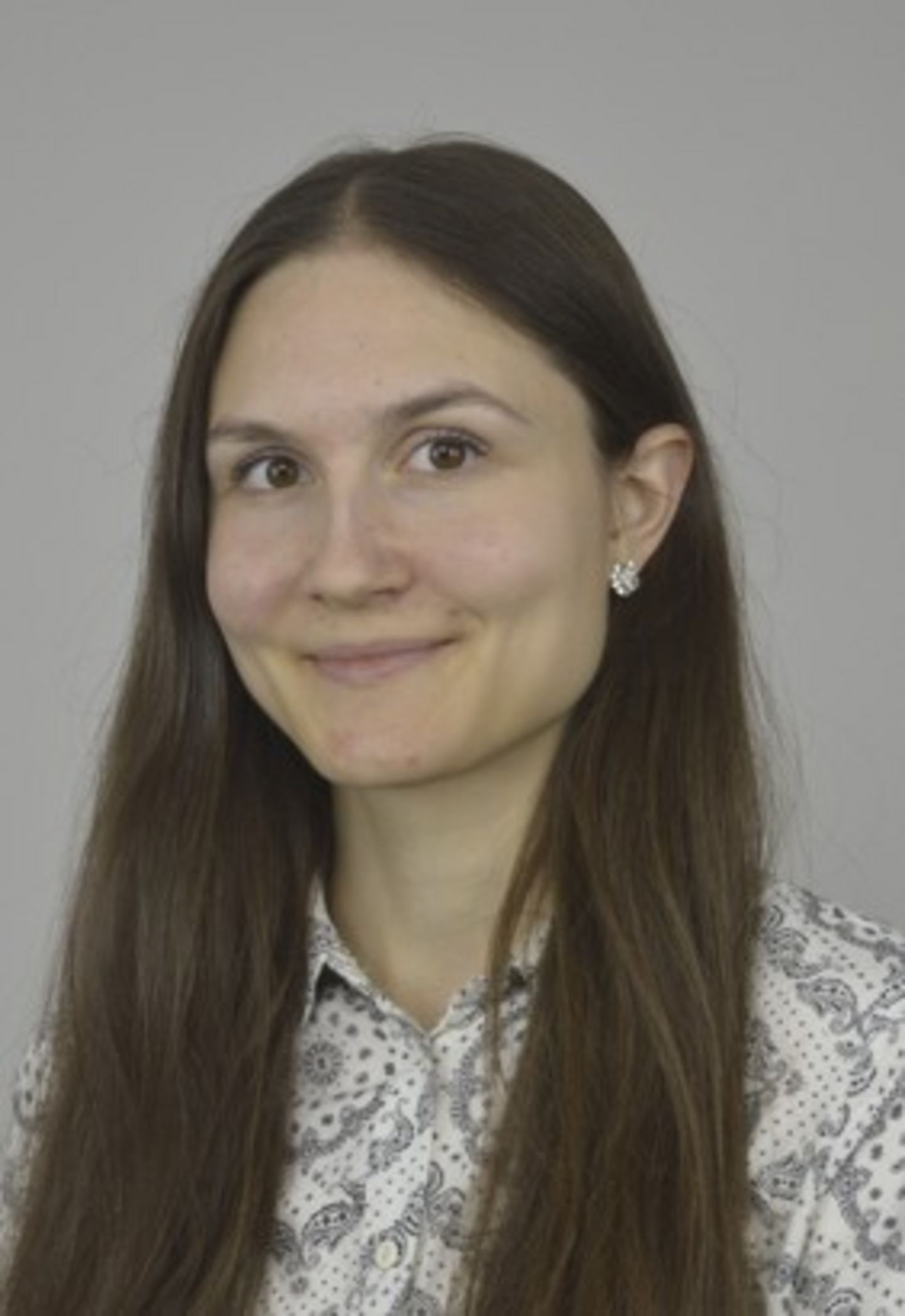
- PhD in the Doctoral College "SOLVER - Skills for Medical Device Research" TU Wien & Hochschule Campus Wien, since Sept. 2025 Project: Multi-luciferase assays for medical device research
- Internship Institute of Science and Technology Austria (ISTA), Kicheva Group – Developmental Biology, Sept. 2024 – Sept. 2025 Project: Understanding the underlying principles of size control during mouse spinal cord development
- MSc in Biotechnology Budapest University of Technology and Economics & Eötvös Loránd University, Feb. 2022 – Jan. 2024 Thesis: Characterizing the transporter interactions of antiparasitic pentamidine analogues
- BSc in Biochemical Engineering Budapest University of Technology and Economics, Sept. 2018 – Jan. 2022
Contact Details: sara.fueloep@hcw.ac.at

Christina Winter
Christina Winter
Christina Winter is a PhD student with a strong passion for medical research and tissue engineering. Already during her secondary education with a focus on biology and chemistry, she developed a deep interest in scientific research. She pursued this path at the University of Natural Resources and Life Sciences, Vienna (BOKU), where she completed her BSc in Food and Biotechnology, followed by a Master’s degree in Biotechnology.
During her Master’s thesis, which focused on establishing a 3D in vitro cytotoxicity model for pancreatic cancer to study T cell–tumor interactions, she discovered her enthusiasm for translational biomedical research. Since April 2025, she has been investigating the biological characterization of biomaterials within the SOLVER doctoral program. Her research aims to comprehensively evaluate how immune and tissue cells respond to biomaterials at molecular and functional levels. Using advanced in vitro systems, including co-culture approaches and 3D models, she studies inflammatory and adaptive immune responses to assess biocompatibility and to better understand the complex interactions between biomaterials and the human immune system.
When she is not in the lab, Christina enjoys spending time outdoors — running, cycling, swimming in lakes, or exploring the mountains. She also appreciates quiet moments with a good book and a cup of coffee.