Agilent Announces Thought Leader Award to Professor Christoph Herwig
![[Translate to English:] Porträt Christoph Herwig](/fileadmin/_processed_/f/6/csm_Herwig_1__c__Michael_Gizicki_2019_4cbe636078.png)
Not all major environmental problems can be solved with big, individual ideas. If we want to make our economy more environmentally friendly, we need to re-think our production processes and technologies and find a myriad of new solutions – in completely different fields.
This research field therefore covers many different aspects, which fit together like puzzle pieces, with the aim of making our economy and industry more environmentally friendly as a whole. In many fields, research is highly application-driven: it is not about big visions for a distant future but about the development of innovative technologies and processes which can then be used directly by industry.
For example, chemical processes in bioreactors are carefully analysed so that the desired chemical products can be produced using biological processes. Many synthetic chemical processes also produce by-products that are damaging to the environment – research groups working on “green chemistry” develop new synthetic processes which are better for the environment. Toxic solvents, for example, have been replaced with hot water in the manufacture of certain high-performance plastics.
The question of how to best use raw biomaterials and which products can be made from improved biomaterials requires a lot of chemical expertise – something which is under continuous development at TU Wien. One field that will gain in economic importance in the not-too-distant future is the biorefinery: biogenic (waste) materials can be recycled using a clever process, thereby helping to reduce our CO2 emissions significantly.
CO2 reduction is generally the aim of many of the other technologies that TU Wien is working on, from engines to combined heat and power stations. This field also includes applications that you might not immediately associate with CO2 emissions – such as ultrasound or laser technology for innovative sensors that can be used for environmental applications.
New forward-looking materials, from special concrete to innovative semi-conductor structures for better photovoltaics, are being developed in conjunction with research groups from other materials research disciplines. The properties of existing materials are being improved – at incredibly different scales, from huge construction elements down to the molecular level. Materials are simulated on the computer, produced, tested and used.
To make industry more environmentally-friendly, however, we need to optimise not only the material, but the production processes themselves. Huge increases in efficiency can often be achieved through precision analysis and optimisation of industrial processes.
Modern IT solutions can be used to proactively control large-scale systems while modern machine technology can be used to lower resource consumption and energy needs. This often requires highly complex simulations and sophisticated computer tools which are developed at TU Wien. Our experts are therefore working across disciplines in the fields of modelling, control, regulation and automation with the latest computer, information and communication technology.
Stadt- und Raumentwicklung der Zukunft
Energie- und ressourceneffiziente Bauwerke (Aktiv-/Passivhaus)
Intelligente Gebäude und Siedlungen
Innovative Immobilienbewirtschaftung und Infrastruktur
Soziologische und Ökologische Aspekte
Resource-efficient production
Bioprocesses and green chemistry
Innovative new technologies and processes
Sustainable materials and their applications
Im Forschungsschwerpunkt Energie und Umwelt sind alle acht Fakultäten der TU Wien vertreten, rund zwei Drittel der Institute. Mehr als 80 Forschungsgruppen forschen gezielt in unterschiedlichsten Aspekten zum Thema Energie und Umwelt.
Das im selben Zeitraum eingeworbene Drittmittelvolumen für den Forschungsschwerpunkt Energie und Umwelt beträgt rund 56 Mio. €.
Der Forschungsoutput in den einzelnen Forschungsfeldern ist unterschiedlich - von den verschiedenen Messzahlen zur Quantifizierung der Forschungsaktivitäten wurden das projekt-finanzierte Personal (Abb. 1) und die Anzahl der publizierten Zeitschriftenbeiträge (Abb. 2) ausgewählt.
Four faculties are active in this field of research in particular – Technical Chemistry and Electrical Engineering and Information Technology account for around two thirds of the project volume. The other two are the faculties of Mechanical and Industrial Engineering and Civil Engineering.
Research groups from 31 institutes are carrying out research into more resource-efficient production as well as innovative technologies and processes. Around 4.8 million euros is invested in around 90 projects per year. There has been a significant rise in the academic output in recent years – this can be seen in the SCI publications in particular.
All data and information provided relates to the research period 2016-2018 (based on the period of the Performance Agreement).

A list of all projects in the research field “Sustainable Production and Technologies” can be found in our project database, opens an external URL in a new window.
A list of all projects in the research field “Sustainable Production and Technologies” can be found in our project database, opens an external URL in a new window.
![[Translate to English:] four people in a lab with technical equipment between them](/fileadmin/_processed_/0/a/csm_Neutrons_Team_63e231ab67.jpg)

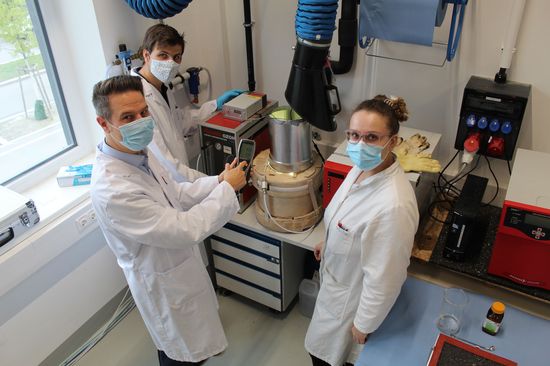
![[Translate to English:] zwei Personen im Labor vor einer metallischen Maschine](/fileadmin/_processed_/d/e/csm_Methanol_Molybdaensulfid_Foto_KF_GP_3_da2f65f800.jpg)