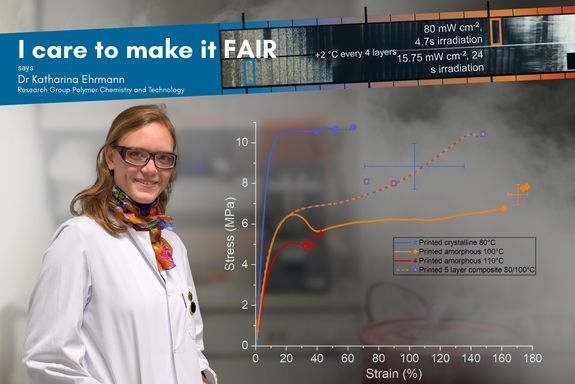
Passing countless laboratories with changing warning signs, we meet Dr Katharina Ehrmann at the Institute of Applied Synthetic Chemistry in the Getreidemarkt building at TU Wien. She is part of the Polymer Chemistry and Technology research group and introduces us to the world of materials chemistry. We talk about printing processes, metadata standards, and the use of AI and chemical intuition. As part of an Elise Richter fellowship, Dr Ehrmann is researching a new synthesis method for so-called multimaterials in 3D printing. For a long time, objects from 3D printers could only be produced from a single continuous material. Her group now uses different light colours to control chemical reactions and material properties in a targeted way, enabling the simultaneous printing of several materials.
From digital objects to print
“In our work, everything starts digitally, with three-dimensional objects that are designed on the computer, and these files are then fed into the 3D printer. And as a materials chemist, it is of course very exciting to introduce new materials for this process and then characterise them.”
The research process begins digitally with so-called CAD designs and STL files, which get fed to the 3D printer, defining what the printer has to build layer by layer. For multimaterial printing, there is the additional challenge of precisely encoding which material is to be printed where and when. What is particularly exciting for Dr Ehrmann is how and whether this multimaterial synthesis works: for this, the materials are characterised using, for example, bending and impact toughness tests, as well as analyses of temperature behaviour, melting points, and crystal structures. These data are now largely collected automatically by instruments and then processed using programs such as Excel or Origin, or first need transformation using specialised software. Each experiment is recorded in a so-called ELN (Electronic Laboratory Notebook) to ensure inventory and laboratory safety; however, there is not yet a uniform rule for when to document analogue versus digital, since workflows differ so much from test to test.
Raw data for better reproducibility
“We also use an analytical method called NMR magnetic resonance spectroscopy. There we look at very small molecules and obtain characteristic spectra, and these data are essentially spat out by the instrument and then have to be transformed before we can interpret them. And in such cases, it absolutely makes sense to store the raw data alongside.”
Dr Ehrmann explains that processed spectra can indeed be neatly stored as XY plots in Excel, but that the preferred approach is to store the raw data in specialised software solutions that include all additional information and instrument parameters. The resolution of the resonance spectra depends on the strength of the magnetic field used, and these metadata should be stored along with the data to ensure the reproducibility of the experiment.
In general, the open science culture in her field is mixed: some researchers routinely publish raw data, others only upon request or in line with journal requirements. For example, crystal structure data in X-ray crystallography are highly standardised, and metadata are mandatory to publish. In her research group, Dr Ehrmann is working to establish a high standard of data management based on the FAIR principles, because the reusability of data is a central concern for her, particularly for transparency and credibility within the community.
Meta-reviews with and without AI support
“Often, I would have liked to include interpretation and context in much greater detail, but that would blow up any metadata set, and especially in materials chemistry there is a lot of trial and error. It is an experimental science, and at some point, the question arises: when is the right moment to stop? What are still meaningful raw data that deserve to be stored, and what no longer?”
The targeted selection and preparation of raw data along the research question and their translation into visualisations is particularly important in meta-analyses in order to identify trends more quickly and avoid duplicate work. For instance, Dr Ehrmann’s research group has produced a comprehensive review on liquid crystalline monomers and their melting points to enable structure–property correlations for multimaterial 3D printing. Liquid crystalline monomers are fundamental for the development of LCD displays, and accordingly, the existing data landscape in this field is vast. Here she emphasises how labour-intensive this literature work is and that currently it cannot simply be replaced by an AI that only has access to insufficiently annotated data, and may only summarise data and papers, without being able to meaningfully interpret graphs and diagrams.
Chemical intuition as a tool for the future
“But a simple summary has actually never really been the true purpose of reviews. A good review should always contain a meta-level. I believe this meta-level will remain reserved for us humans for a very long time – it requires chemical intuition, where textbook knowledge comes together with experience, because the public domain is often a bottomless pit.”
Dr Ehrmann sees great potential in centralised and standardised data management systems so that knowledge, extensive metadata, and even unexpected side reactions remain accessible for future researchers in her group. Her research is intended to flow into practical applications long term and improve everyday materials. In conclusion, she stresses how important an experimental approach is for her work: understanding which parameters are relevant and what can be optimised, combined with thorough literature research. For Katharina, chemical intuition means deriving new, unexpected ideas from what she has read and, thanks to her own experience, being able to judge which synthesis is likely to work in practice, under very constrained conditions in the 3D printer.
Contact
Dr Katharina Ehrmann
Institute of Applied Synthetic Chemistry
TU Wien
katharina.ehrmann@tuwien.ac.at
Center for Research Data Management
TU Wien
research.data@tuwien.ac.at