Sustainability
“A culture of sustainability” – as a defining and unifying guiding principle for TU Wien!
Sustainability is established as one of the eight strategic objectives within the fuTUre fit strategy, opens in new window, and, as a cross-cutting theme, also addresses the other strategic objectives:
“Establish sustainability as a central principle in research, teaching and university operations.” (strategic goal 6)
© TU Wien
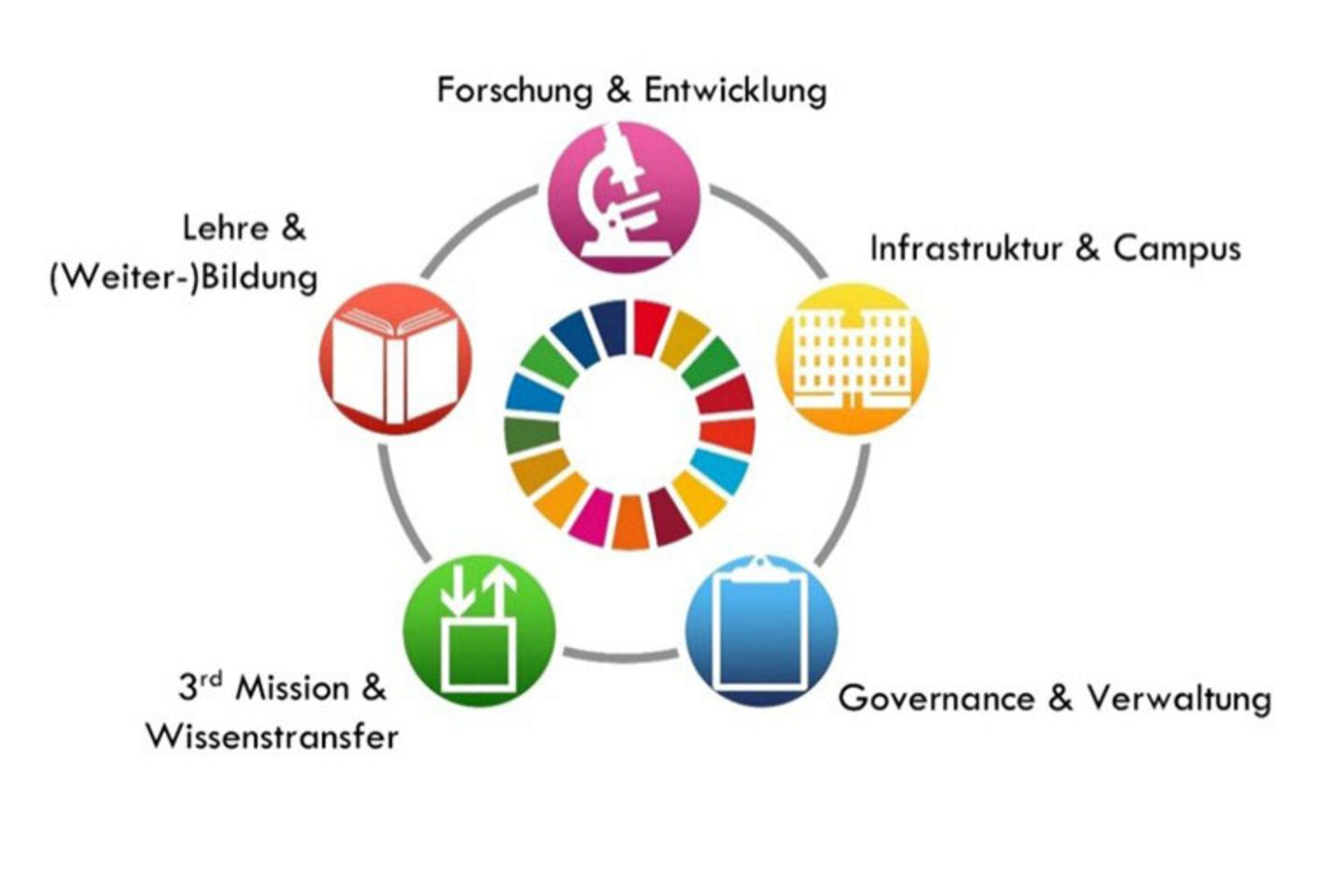
Areas of action for sustainability at universities are essentially based on the ‘Whole Institution Approach’. Sustainability management at TU Wien is therefore divided into several areas – alongside the core tasks of teaching and research, active engagement with society, as well as operational processes and governance issues, play a particularly important role:
Sustainable research is interdisciplinary and transdisciplinary in nature and is based on a balance between academic freedom and social responsibility. It addresses the pressing challenges of the present day, considers their potential environmental, economic and social impacts, and contributes to the necessary processes of transformation.
Embedding sustainable development in teaching requires equipping students to play an active role in shaping social change. The close link between research and teaching, and the acquisition of subject-specific skills, is just as crucial as the development of skills in systemic, critical and reflective thinking, and in collaborative learning and action.
As a fundamental educational principle, sustainability must also be incorporated into the continuing professional development of teaching staff and all members of staff in order to ensure lifelong learning and empowerment.
(Knowledge) transfer activities are a key aspect of academic work and the university’s social responsibility – they are becoming increasingly important in view of the complexity of the challenges and crises we face. A new interplay between politics, society, academia and business (within the framework of ‘co-creation of knowledge for sustainability’) defines the challenges of the sustainability transition and thus goes beyond knowledge transfer within the context of the Third Mission – becoming the Fourth Mission: it is about learning from and with one another.
In order to establish a culture of sustainability at all levels of the institution, the sustainability transformation – as a cross-cutting issue – must also be embedded within its structures and administrative processes. The basis for this is to actively involve all staff and students in a transparent process of sustainable development, with a view to adopting a ‘whole institutional approach’, and to shape this as a flexible, learning-based concept characterised by ongoing reflection.
Running a university in line with sustainability criteria requires long-term strategies and life-cycle-based approaches, particularly in the areas of energy and facilities management, procurement and IT. The consistent development of the infrastructure and the campus, guided by resource-efficient and socially responsible criteria in both design and operation, requires collaboration with internal and external partners and serves as a model and catalyst for sustainable action.
Sustainable Campus | TU Wien
Operational Goals
To operationalise sustainability, three time horizons have been defined, which are linked to the performance agreement ("Leistungsvereinbarungs") periods. Each area of action includes a short-term, a medium-term and a long-term objective.
(F1) A comprehensive overview exists of TU Wien’s research output on sustainable technologies, processes and developments, as well as their implementation.
(L1) Sustainability is incorporated into the curriculum and established as a micro-credential.
(M1) TU Wien is represented in key university-level sustainability initiatives and plays an active role in shaping, learning from and contributing to them.
(G1) Sustainability is integrated into TU Wien’s quality assurance and decision-making processes.
(I1) A greenhouse gas inventory has been drawn up and greenhouse gas emissions have been reduced.
(F2) Responsible research practices and relevant topics relating to sustainable transformation are addressed even more extensively in research.
(L2) Interdisciplinary and transdisciplinary teaching formats have been established for the implementation of sustainability in teaching.
(M2) The University of Technology is actively engaged in societal discourse and contributes to raising awareness both within and outside the university, as well as to the transfer of knowledge for sustainable development.
(G2) Mobility at the University of Technology is organised in a more sustainable manner.
(I2) The efficient use of resources is ensured through sustainable operational management.
(F3) The technological and process expertise of TU researchers is systematically incorporated into the sustainable development of administrative processes and infrastructure.
(L3) Sustainability is enshrined as a fundamental principle of education and training at TU Wien.
(M3) An innovation ecosystem for sustainable tech and deep tech has been established at TU Wien and is making an international impact.
(G3) Communication is a natural part of TU Wien’s sustainability culture.
(I3) TU Wien is designed as a green, climate-resilient campus where innovative solutions are tested in living labs and sustainable contributions are made transparent.
The current focus is on systematically consolidating existing activities and further developing initiatives across the various areas of action. The main priority is the development of an overarching sustainability framework that translates the strategic guidelines into a coherent, action-oriented whole. Key measures and appropriate performance criteria are being defined for all areas of action to ensure that progress is not only visible but also traceable and verifiable.
A defining feature of this stage is the parallel development and implementation: concepts are not devised in isolation, but are refined, reviewed and further developed through practical application. Experience feeds directly back into the conceptual work – a learning process that is highly practical and impact-oriented.
KlimaTicket Promotion

© One Mobility GmbH
Through its financial contribution to the KlimaTicket Ö, TU Wien is promoting climate-friendly and resource-efficient behaviour.

Dipl.-Ing.Iva Ilieva

Dipl.-Ing. Dr.techn.Gudrun Weinwurm
KlimaTicket Promotion
© One Mobility GmbH
Through its financial contribution to the KlimaTicket Ö, TU Wien is promoting climate-friendly and resource-efficient behaviour.
Dipl.-Ing.Iva Ilieva